The Magic of AMQ
Approximate membership queries are one of those quiet infrastructure ideas that feel like cheating until you realize the trick is restraint.
Some infrastructure questions become too expensive just by being asked often enough.
Is this IP hot?
Has this tenant crossed a boundary?
Does this key belong to the set of things we should treat differently right now?
At small scale, you ask the question directly. You look in a database, call a cache, increment a counter, wait on a network hop, and move on with your day. At meaningful scale, that little moment becomes a tax on everything. The rate limiter becomes the thing being rate limited. The system built to protect your product becomes another dependency your product has to survive.
This is where approximate membership queries start to feel like magic.
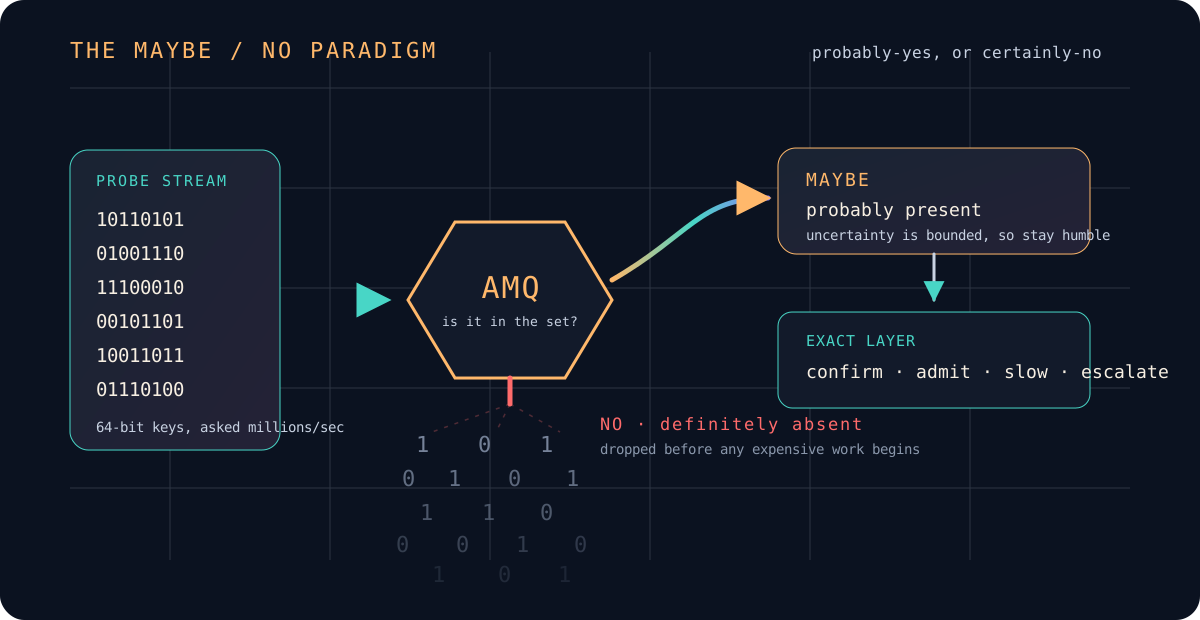
An AMQ does not try to answer every question. It answers a narrower one, absurdly fast: “Is this thing probably in this set?” The word probably makes engineers nervous, which is fair. Infrastructure is full of places where approximate is a synonym for “future incident report.” But used in the right layer, with the right blast radius, probability becomes a lever instead of a liability.
The magic is not that an AMQ is fuzzy. The magic is that it lets you move a huge amount of decision-making out of the expensive path.
The Shape of the Trick
The common reflex is to put the source of truth on the hot path. That feels safe. Every request gets a fresh ruling from the canonical system. Every decision is auditable. Every counter is exact.
It also means every request pays for ceremony.
AMQs invert that shape. They are better understood as compact, read-only snapshots of intent. Build the snapshot somewhere else. Publish it atomically. Let the hot path ask a tiny local question with predictable memory access and no remote call. If the answer is boring, keep moving. If the answer is interesting, hand it to the slower, more exact layer.
That division is the useful part. The AMQ is not the court of final appeal. It is the sensor at the perimeter.
In ART, that distinction matters. The fast path is allowed to be fast because it is not pretending to be a ledger. It is a gate, tuned for early separation: known-good traffic can pass without drama, obviously bad traffic can be stopped before it burns more system, and the ambiguous middle can fall through to controls that know more.
This is one of those designs that sounds modest until you look at what it removes. No cache trip. No serialized durable object. No distributed counter on the first contact. No external dependency sitting between an attacker and your own CPU budget. The machine can make the first decision with the data already in its hands.
Why It Feels Like Cheating
AMQs are strange because they spend uncertainty in one place to buy determinism in another.
The uncertainty is bounded: a lookup can occasionally say “present” for something that was not in the set. The determinism is operational: memory stays bounded, lookup cost stays flat, and the hot path does not suddenly become a networked conversation.
That trade matters when the cost of a miss and the cost of a false alarm are not symmetric.
For a rate-control perimeter, a false negative would be unacceptable: if something is in the block snapshot, you need to find it. A false positive is different. It is a signal to slow down, confirm, or route through a secondary path. If you design the rest of the system to treat that signal with humility, the occasional false alarm becomes manageable.
This is why I like AMQs as infrastructure primitives. They force you to be honest about the job of each layer.
The perimeter should be cheap.
The ledger should be exact.
The rebuild loop should be boring.
The observability should tell you when the assumptions are drifting.
Together, those pieces give you a system that behaves less like a wall and more like a set of pressure valves. It can react quickly without asking every request to drag the whole control plane behind it.
When an AMQ Grows Up
Most people meet AMQs through the Bloom filter. That is the intro class version, and Bloom deserves respect. But stopping there is like studying arrays and deciding a spreadsheet is the end of data structures.
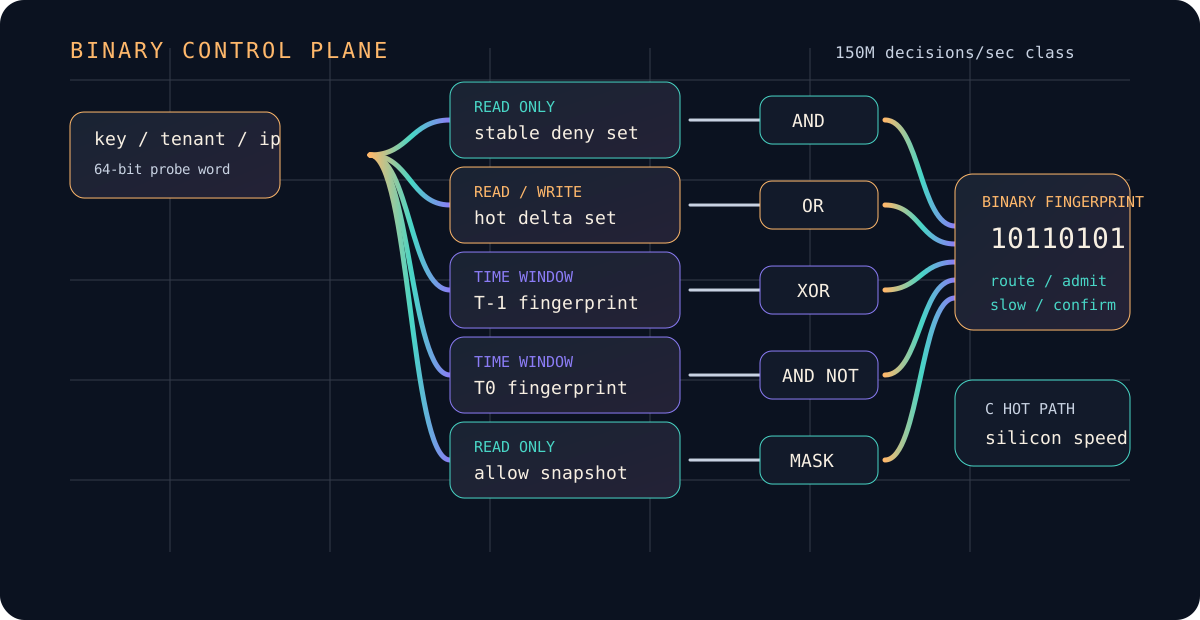
The family is larger than the intro class suggests: read-only snapshots, read-write deltas, counting variants, quotient-like layouts, xor-style filters, compressed fingerprints, time-bucket comparisons, and compositions that behave less like a single set and more like a small logic fabric. The name of the structure matters less than the operations it makes cheap. Once membership becomes compact binary evidence, set logic gets interesting.
Now the hot path can ask more than one question without becoming slow:
- Is this key in the stable deny set?
- Is it absent from the allow snapshot?
- Did it appear in the current window but not the previous one?
- Does a delta set override the read-only baseline?
- Do several independent hints combine into a binary fingerprint worth acting on?
This is where AMQs grow up. They stop being a cute probabilistic container and become a control plane.
I like doing this close to the metal. C, fixed-width words, predictable memory access, and the speed of silicon. If the operation is shaped correctly, the machine can make an absurd number of first-pass decisions before a heavier system has finished clearing its throat. In my own work, I use these ideas to make on the order of 150 million control decisions per second without much drama.
The useful word there is control. Not truth. Not final judgment. Control.
An AMQ-backed control plane can decide whether to admit, slow, route, sample, confirm, suppress, or escalate. The exact layer still exists. The ledger still exists. The human-readable policy still exists. But the first binary fingerprint can be cheap enough to sit in front of everything.
This was the nature of the patent work: not “we used Bloom filters,” which would be a very short and very boring story, but the way families of approximate sets, logical operations, time comparisons, and confirmation layers can be composed into a practical control surface. I am deliberately staying at that level. The magic is in the architecture, not in handing out a build sheet.
When an AMQ grows up, it becomes something stranger than the classroom version. It is still just bits, bounds, and disciplined failure modes, but the design space opens up. The limit is no longer the data structure you learned first. The limit is imagination.
The Part I Will Not Publish
There is a real implementation story here, and some of it is the subject of patent work. I am not going to publish the construction details, tuning rules, rebuild strategy, or the specific ways ART composes AMQs with confirmation and control layers. A perfect recipe would be useful to competitors and boringly irresponsible for us.
The public lesson is enough:
If your system has to ask the same membership question millions of times, stop treating each question like a bespoke legal proceeding. Separate the fast question from the exact question. Make the fast question local, bounded, and read-only. Make the exact question responsible for consequences.
That mental move is the doorway.
A Small Enough Answer
The best infrastructure trick is rarely a bigger hammer. It is usually a smaller answer.
AMQs are small answers. They refuse to know everything. They know one thing cheaply, over and over, with a failure mode you can design around. That refusal is what makes them useful.
When people talk about AI infrastructure, they usually talk about GPUs, schedulers, tokens, and model weights. Those are the loud parts. But a lot of the future will be decided by quieter machinery: admission control, fairness, abuse resistance, cost envelopes, and the tiny decisions that happen before expensive work begins.
AMQs shine there. They let the system ask, “Have I seen enough to treat this differently?” before it commits to anything heavy.
Not certainty. Not prophecy. Just a tiny, fast, bounded maybe.
Run it fast enough, and that maybe starts to feel like magic.